
UBAID ALI KHAN
Data Scientist
Excel | SQL | Power BI | Python
PORTFOLIO
EXCEL
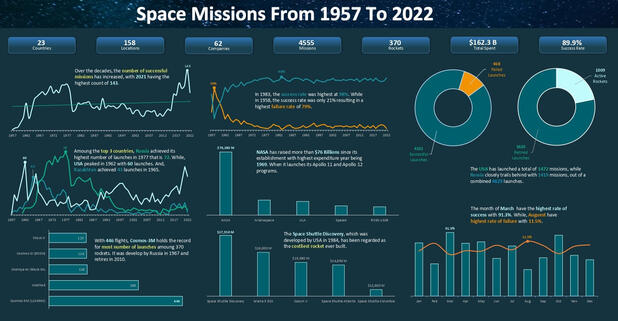
Space Missions
Excel report meticulously examining space missions spanning the years 1957 to 2022.
POWER BI
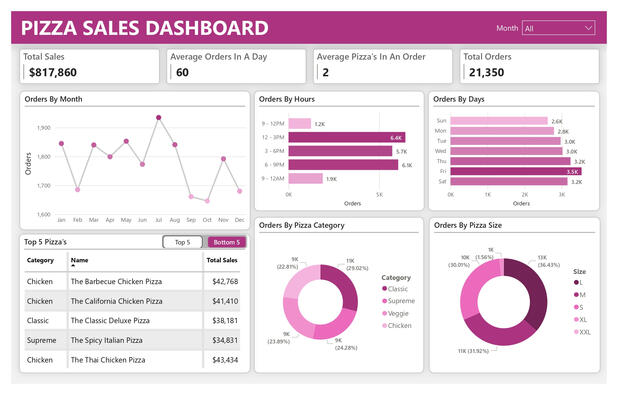
Pizza Sales Analysis
Analyzing a year's worth of sales & customer buying behavior from a fictitious pizza place.
CERTIFICATIONS
RESUME
Power BI | Pizza Sales
Business Problem:
1. The business problem asks four key questions:
2. How many customers do we have each day? Are there any peak hours?
3. How many pizzas are typically in an order? Do we have any bestsellers?
4. How much money did we make this year? Can we identify any seasonality in the sales?
5. Are there any pizzas we should take off the menu, or any promotions we could leverage?
What Was Done:
With the aid of a robust multi-table pizza sales dataset sourced from Maven Playground, comprising approximately 50,000 records, I successfully crafted an intuitive and comprehensive dashboard using Power BI.The initial step involved thorough data cleaning using Power Query, streamlining the dataset for optimal analysis. Subsequently, I delved into data modeling and employed DAX functions to define key measures, enabling profound insights into the data.I incorporated supplementary columns and an indispensable "Date" table to facilitate an in-depth examination of seasonal trends and patterns in the pizza sales data.
Key Insights:
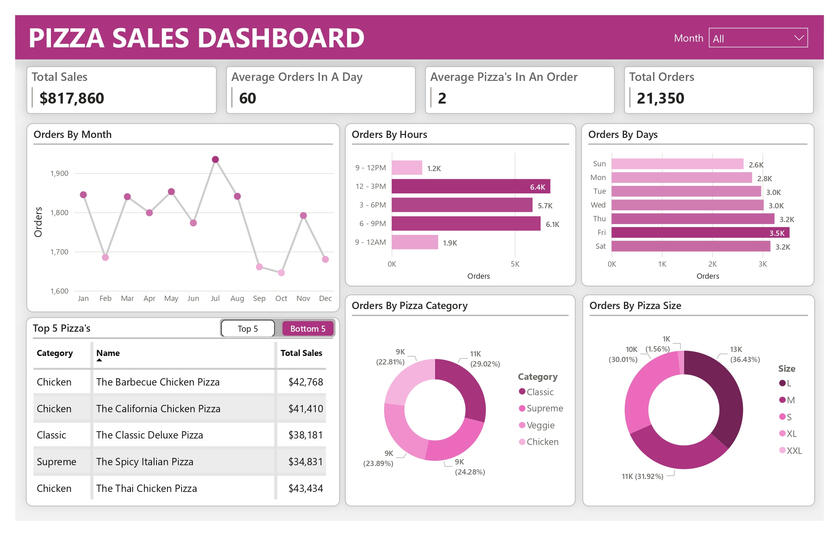
In analyzing the pizza sales data, several key insights emerge.On average, the company receives 60 orders per day, with peak hours observed between 12 pm and 9 pm. The months of July and August see the highest sales, aligning with the peak days of Thursday, Friday, and Saturday. Most orders consist of an average of 2 pizzas.Among the pizzas offered, the best-sellers include barbeque chicken pizza, California chicken pizza, classic deluxe pizza, spicy Italian pizza, and Thai chicken pizza. Conversely, the least popular pizzas are spinach pesto pizza, mediterranean pizza, spinach supreme pizza, green garden pizza, and brie carre pizza.In total, the sales revenue amounts to an impressive $817,860.
Thanks!
Excel | Space Missions
About This Project:
Infusing my Passion for Space and Astronomy, my Excel project provides a meticulously curated report that unveils the captivating narrative of space missions spanning the years 1957 to 2022.This project has been built using an expansive dataset, meticulously encompassing the entire spectrum of space missions, a foundational cornerstone that allows for insightful exploration.
Business Problem:
1. How have rocket launches trended across time? Has the mission success rate increased?
2. Which countries have had the most successful space missions? Has it always been that way?
3. Which rocket has been used for the most space missions? Is it still active?
4. Are there any patterns you can notice with the launch locations?
What Was Done:
Starting with the finer details of cleaning data, the report takes shape, making things clear and precise. I've skillfully picked out important info, creating special columns like "country" from tricky locations column and smoothly putting together month and year details from complex dates.As I've dived into the data, my focus has shifted toward analysis. Using Excel's smart analysis tools, I've uncovered trends, achievements, and cool insights that were hidden in the data. Calculations help us see the mission details better.By blending numbers and stories, I've created visual magic. My report turns data into eye-catching graphs, revealing patterns and big moments. This visual show helps us understand things deeply, going beyond just numbers.
Key Insights:
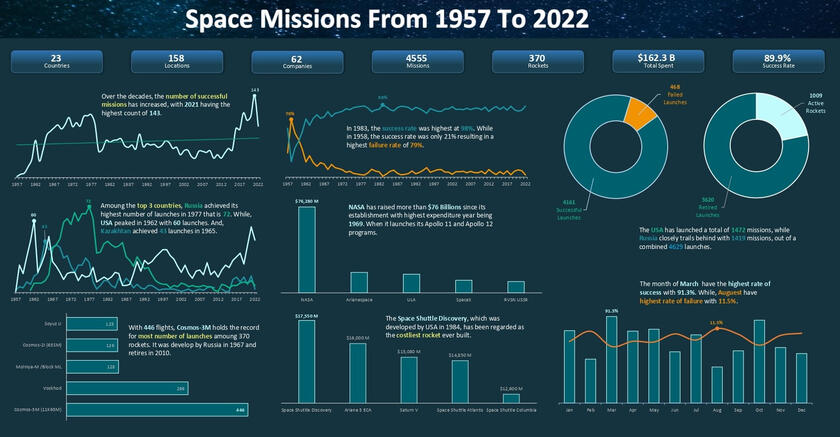
The report pays great attention to details and shares a bunch of important info. Here are some main points to take away:Successful missions have increased each year, hitting a high of 143 in 2021. The top three countries with the most missions are Russia, the USA, and Kazakhstan. The Cosmos-3M rocket holds a record for the most launches – a whopping 370 times before retiring in 2010. When it comes to spending, NASA takes the lead, investing a whopping $76 billion in space missions.